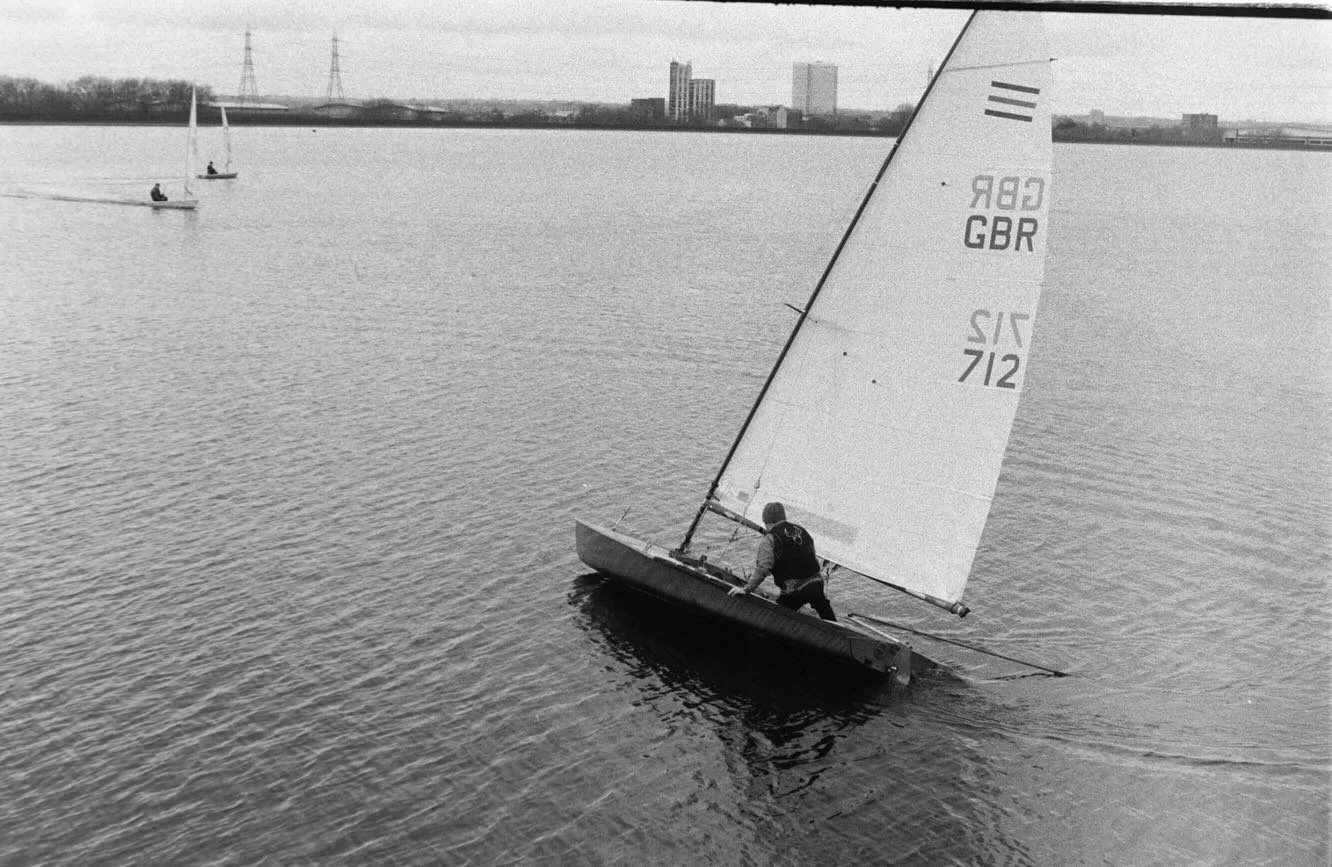
The best way to become a better sailor is not necessarily to spend more time on the water. It is to make the time you already spend on the water more purposeful.
Have you ever come ashore after a day's sailing knowing that you were not quite as quick as you could have been, but without being able to put your finger on exactly why?
Perhaps another boat seemed to point higher into the wind. Perhaps you lost ground through every tack. Maybe your downwind sailing felt untidy, or you found yourself constantly reacting to the boat rather than being one step ahead of it.
It is an experience most sailors recognise.
The obvious answer is to go sailing more often. And, of course, time on the water matters. But simply repeating the same sailing habits over and over again does not necessarily make us better sailors.
A more effective approach is to train deliberately.
That means identifying something you want to improve, learning what good technique looks like, practising it deliberately on the water, and then reviewing what happened.
In other words:
Learn. Practise. Observe. Review. Repeat.
There is now a wealth of excellent sailing instruction available without having to book a coach or attend a training camp. DVDs, digital downloads and online video can give sailors access to high-quality coaching whenever they want it.
Two particularly useful resources are Rooster Sailing's Boat Whisperer instructional material and the International Sailing Academy's extensive collection of tips, tricks and videos.
The important thing, however, is not simply to watch them.
It is to use them as part of your training.
Start with one thing
One of the biggest mistakes we can make when trying to improve our sailing is attempting to improve everything at once.
We go afloat determined to sail faster, tack better, steer better, improve our sail trim, read the wind, hike harder and make better tactical decisions.
Within ten minutes, we have forgotten most of it.
Instead, choose one thing.
It could be as simple as:
maintaining speed through a tack;
steering smoothly upwind;
keeping the boat balanced in gusts;
improving your downwind steering;
becoming more consistent with gybes;
learning to recognise changes in wind pressure; or
improving your sail trim.
The objective does not even have to be complicated.
Rather than saying, "I want to be faster today", say:
"For the next 20 minutes, I am going to concentrate on steering smoothly and keeping the boat moving through every tack."
That is something you can actually practise.
And importantly, you can succeed at the exercise even if you do not win the race.
Learn before you go sailing
One of the advantages of modern sailing video is that we no longer have to wait until the next training session to learn.
Rooster's Boat Whisperer collection, for example, includes separate instructional material covering tactics, upwind and downwind sailing, available as DVDs and digital downloads. Rooster's current search results list Boat Whisperer Tactics, Upwind and Downwind material, including digital versions.
That makes these resources particularly useful as preparation for a sailing session.
Suppose you know that you are struggling with your upwind speed.
Rather than simply going sailing and hoping it improves, spend some time beforehand studying the subject.
Watch how an experienced sailor handles the boat.
Look at the relationship between steering, sail trim and boat balance.
Notice what happens when the wind increases or decreases.
Then go afloat with one or two specific things to try.
You have turned a video into a lesson.
Don't just watch — watch like a sailor
There is a difference between watching sailing video for entertainment and watching it to improve.
When watching instructional footage, pause occasionally and ask yourself questions.
Where is the sailor looking?
What is the boat doing?
How much is the tiller moving?
When does the sailor trim or ease the sail?
What happens to the boat when a gust arrives?
How is the sailor moving their body?
What happens immediately before and after a tack or gybe?
These observations are often more valuable than simply listening to an explanation.
The next time you go sailing, try to reproduce just one of the things you noticed.
You may be surprised how much easier it is to understand a technique once you have seen it performed repeatedly.
Use the International Sailing Academy as your online coach
The International Sailing Academy provides another useful source of material, particularly for sailors who want to concentrate on individual aspects of boat handling and performance.
Its ILCA Tips & Tricks library covers a wide range of subjects, providing sailors with a way of exploring particular techniques rather than having to work through a single fixed course.
This is particularly valuable when you have identified a weakness.
Perhaps you are comfortable sailing in a straight line but struggle in waves.
Perhaps your tacks are inconsistent.
Maybe you lose speed whenever the wind becomes lighter.
Instead of searching randomly for advice, choose the problem and study that specific area.
The International Sailing Academy also has a YouTube channel, making shorter pieces of instructional material readily available when you want a quick reminder or a different explanation.
Think of these resources as a library that you can dip into whenever you need them.
Your best coach might be a camera
One of the most powerful training tools available to the ordinary sailor is also one of the simplest: video of yourself sailing.
Watching an expert sailor is useful.
Watching yourself can be even more revealing.
What we think we are doing and what we actually do are often two different things.
You might believe that you are steering smoothly, only to discover that the tiller is constantly moving.
You might think you are completing your tacks efficiently, only to see that the boat loses a significant amount of speed during every manoeuvre.
You might feel that you are sitting in the right position, but video may show that your body movement is affecting the balance of the boat.
You don't need hours of footage.
A friend with a phone can record a few minutes of upwind sailing, several tacks, some downwind sailing and a few gybes.
Then watch it later.
But again, don't try to analyse everything.
Choose one question.
What am I doing with the tiller?
Or:
What happens to the boat when I tack?
Or:
How quickly do I respond to a change in the wind?
The aim isn't to criticise yourself.
It is to find something specific that you can improve.
Upwind: speed is about consistency
Upwind sailing often exposes weaknesses because there is nowhere to hide.
A small steering error, poor sail trim or badly timed movement can cost speed.
It is tempting to concentrate entirely on pointing as high as possible.
But pointing high is not necessarily the same as sailing fast.
A good training exercise is to concentrate on speed first.
Feel what the boat is doing.
Watch the sails.
Pay attention to the tell-tales if you use them.
Notice the effect of small steering movements.
Try sailing slightly freer and allowing the boat to accelerate. Then gradually head up again.
The objective is to develop a feel for the boat rather than relying entirely on a fixed steering position.
This is where instructional footage can be particularly valuable. Watch how an experienced sailor reacts rather than simply looking at where the boat is pointing.
The aim is to develop an instinctive connection between wind, sails, steering and boat speed.
Tacking: make the manoeuvre part of the training
Tacking is another area where deliberate practice can produce rapid improvement.
Instead of treating a tack as something that simply happens while sailing, practise it as a separate skill.
Ask:
Is the boat at good speed before the tack?
Is the turn smooth?
Am I moving at the right moment?
How much speed do I lose?
How quickly does the boat accelerate afterwards?
Try doing a series of tacks with the sole objective of making each one as consistent as possible.
The winner is not necessarily the sailor who performs the most spectacular tack.
It is the sailor who can repeat a good tack again and again.
Consistency is speed.
Downwind: don't switch off
Downwind sailing can sometimes feel like the easy part of the race.
The apparent lack of effort can be deceptive.
There is still plenty to work on: steering, sail trim, boat balance, body position, wind pressure and decisions about when to gybe.
This is an area where the Boat Whisperer Downwind material can be particularly useful because it allows you to study the technique away from the distractions of actually trying to keep the boat moving.
Rooster Sailing – DVD and digital sailing instruction
Then take one idea onto the water.
Don't try to copy everything.
Instead, concentrate on what happens when you make a particular steering or trim adjustment.
Does the boat accelerate?
Does it slow down?
Does the helm become lighter?
Does the boat become easier to control?
Over time, these observations become feel.
And feel is one of the things that separates a competent sailor from a really good one.
Sailing faster is not just about equipment
It is easy to become distracted by equipment.
A new sail.
A different control line.
A new tiller extension.
A better-fitting wetsuit.
Perhaps even a new boat.
Equipment certainly matters, particularly when racing at a high level. But changing equipment will not automatically correct poor technique.
Before spending money to solve a performance problem, ask a simpler question:
Do I actually know what the problem is?
If you don't, more equipment may simply make an existing problem more expensive.
Learning to recognise what the boat is telling you is far more valuable in the long term.
Learn to recognise the wind
Better sailors are not simply better at controlling their boats.
They are also better at noticing what the wind is doing.
Look at the water.
Watch other boats.
Notice darker patches approaching.
Look at flags, trees and ripples.
Feel changes in pressure on your face.
Then compare what you see with what happens to the boat.
If the wind increases, what happens?
If it decreases, what happens?
Does the boat accelerate immediately, or does it need a change in steering or sail trim?
The more attention you pay, the more information you start to receive.
Eventually you stop consciously analysing every change.
You simply start to feel it.
Don't forget tactics
Boat handling and boat speed are only part of sailing.
If you are racing, tactical awareness matters too.
Rooster's Boat Whisperer Tactics material provides another way to study the decisions that sit alongside boat handling.
The important thing is to connect tactics with boat speed.
There is little benefit in making a brilliant tactical decision if you then lose several boat lengths because your tack was poor.
Equally, there is little point in being the fastest boat on the water if you repeatedly sail the wrong side of the course.
Improvement therefore needs to happen on several levels:
Boat handling.
Boat speed.
Wind awareness.
Tactics.
The trick is still to work on them one at a time.
Build your own training programme
You don't need a formal coach standing beside you every time you sail.
You can create a simple training cycle yourself.
Before sailing
Decide what you want to improve.
Find a relevant instructional video or article.
Watch it carefully.
Choose one or two things to concentrate on.
During sailing
Practise the technique.
Repeat it.
Try to notice the effect of each change.
Don't worry if it isn't perfect immediately.
After sailing
Ask yourself three questions:
What improved?
What didn't?
What will I try next time?
Then go back to the instructional material.
Watch it again.
You will often understand something differently after experiencing it on the water.
That is where the real learning happens.
A simple training session
The next time you have a spare half-hour on the water, try this.
Five minutes: get settled.
Sail normally and get a feel for the conditions.
Ten minutes: practise one technique.
Perhaps tacking, steering or sail trim.
Repeat it several times.
Ten minutes: experiment.
Change one variable.
Steer slightly differently.
Trim slightly differently.
Change your body position.
Notice what happens.
Five minutes: review.
Ask yourself what produced the best result.
It is a remarkably simple approach.
But it is much more likely to produce improvement than spending the entire session sailing around without a particular objective.
The sailor who keeps learning keeps improving
Perhaps the most important change is psychological.
Good sailors are rarely finished learning.
Even highly experienced sailors continue to look at technique, analyse video, discuss ideas and experiment.
The difference is that they have learned how to learn.
They don't necessarily expect every session to be perfect.
They expect every session to teach them something.
That is an important distinction.
The next time you go sailing, don't simply ask:
"Did I sail well?"
Ask:
"What did I learn?"
Then find something to work on.
Watch an instructional video. Study another sailor. Film yourself. Try a different technique. Make a note of what happened.
Then do it again.
Because becoming a better sailor isn't about finding one magic tip that suddenly makes you faster.
It is about making small improvements, understanding why they work, and turning them into habits.
Stop just sailing. Start training.
And the next time you come ashore, make sure you know exactly what you are going to work on when you go afloat again.
Useful resources
Rooster Sailing – Boat Whisperer DVDs and Digital Downloads
International Sailing Academy – Tips & Tricks
International Sailing Academy – YouTube
Always adapt sailing exercises to your boat, experience and conditions, and put safety first.